
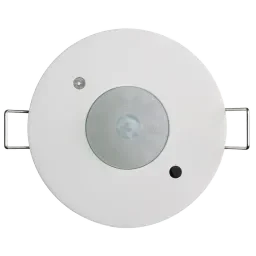
Basic Information
| Product ID | 2031 |
| Version | 0003 |
| Category | Sensor |
| Subcategory | Motion Sensor |
| Profiles |
Ambient Light Sensor NLC Profile 1.0Basic Lightness Controller NLC Profile 1.0Basic Scene Selector NLC Profile 1.0Dimming Control NLC Profile 1.0Energy Monitor NLC Profile 1.0Occupancy Sensor NLC Profile 1.0
|
| Interop Rating | (3/4) |
| Mesh Features | Relay, Proxy, Friend |
Notes
PIR motion sensor and ambient light sensor.
Elements & Models
Element 0
Manages device configuration such as adding/removing keys, publishing settings, and subscription lists. Present on every mesh node.
Reports device health status and performs self-tests. Allows monitoring of node functionality and diagnostics.
Controls binary states (on/off) such as switches, relays, or simple lighting control.
Sends on/off commands to Generic OnOff Servers, such as wall switches or app controls.
Controls continuous values (0-100%) like dimmer levels, fan speeds, or motor positions.
Sends level commands to Generic Level Servers, such as dimmer switches or rotary controls.
Sets default timing for smooth transitions between states (e.g., fade duration for lights).
Controls device behavior when power is restored after power loss (off, on, or restore previous state).
Configures power-on behavior settings for devices with persistent memory.
Reports sensor data like temperature, humidity, motion, or light levels to the network.
Configures sensor parameters like sampling rates, thresholds, and reporting intervals.
Provides current time information and timezone data to the network.
Configures time settings including timezone, TAI-UTC offset, and time authority.
Recalls predefined scenes with multiple device states (e.g., lighting moods).
Stores scene definitions, allowing creation of custom lighting scenarios.
Sends scene recall and control commands to Scene Servers.
Schedules automatic actions based on time, date, or recurring patterns.
Configures scheduler entries with time triggers and associated actions.
Controls the brightness/intensity of lighting devices with smooth dimming capabilities.
Configures lightness parameters like minimum/maximum levels and fade curves.
Controls and monitors Light LC automated lighting systems.
Receives a firmware image from other nodes.
Sends a firmware image to other nodes.
Sends information about a firmware update.
Manages distribution of firmware updates.
Custom model implementation specific to this vendor. Provides proprietary functionality beyond standard Bluetooth® mesh models.
Element 1
Controls binary states (on/off) such as switches, relays, or simple lighting control.
Reports sensor data like temperature, humidity, motion, or light levels to the network.
Configures sensor parameters like sampling rates, thresholds, and reporting intervals.
Recalls predefined scenes with multiple device states (e.g., lighting moods).
Stores scene definitions, allowing creation of custom lighting scenarios.
Schedules automatic actions based on time, date, or recurring patterns.
Configures scheduler entries with time triggers and associated actions.
Provides automated lighting control based on occupancy, ambient light, and time schedules.
Configures Light LC parameters like sensor thresholds, timeouts, and control algorithms.
Receives a firmware image from other nodes.
Receives information about a firmware update.
Element 2
Reports sensor data like temperature, humidity, motion, or light levels to the network.
Configures sensor parameters like sampling rates, thresholds, and reporting intervals.